

AML Supervisory Authorities in the UK
AML Supervisory Authorities in the UK: At a glance
- AML Supervisory Authorities in the UK are the Financial Conduct Authority (FCA), the Professional Body Supervisors (PBS), His Majesty’s Revenue and Customs (HMRC), and the Gambling Commission (GC).
- AML Regulatory Authorities oversee the activities carried out by financial and high-risk sectors and relevant persons.
- Routine inspections by Regulatory Authorities are crucial for assessing deficiencies in the AML programmes implemented by businesses.
- It is pertinent for firms and businesses to take steps to address deficiencies by placing additional AML checks and implementing remediation plans.
What does AML Supervision mean in the UK?
AML supervision in the UK refers to the oversight of relevant persons engaged in activities within the scope of the Money Laundering, Terrorist Financing and Transfer of Funds (Information on the Payer) Regulations 2017 (MLR) by the AML Supervisory Authorities in the UK.
It is crucial to understand the AML Legal Framework in the UK to gain a better understanding of the AML supervision in the UK.
The Supervisory Authorities that regulate AML in the UK are listed under Regulation 7 of the MLR 2017 and include the Financial Conduct Authority (FCA), the Professional Body Supervisors, His Majesty’s Revenue and Customs (HMRC), and the Gambling Commission (GC).
This supervision reflects the wider approach undertaken by the UK to combat economic crime and corruption. It entails the Supervisory Authorities to oversee the application of MLR across its respective sectors.
This is only possible with clear and proportionate anti-financial crime regulations in place that work collaboratively with the Supervisory Authorities in the UK.
AML Supervisory Authorities in the UK
The Supervisory Authorities play a critical role in implementing the AML regime across all sectors in the UK. The AML supervisor by sector in the UK is as follows:
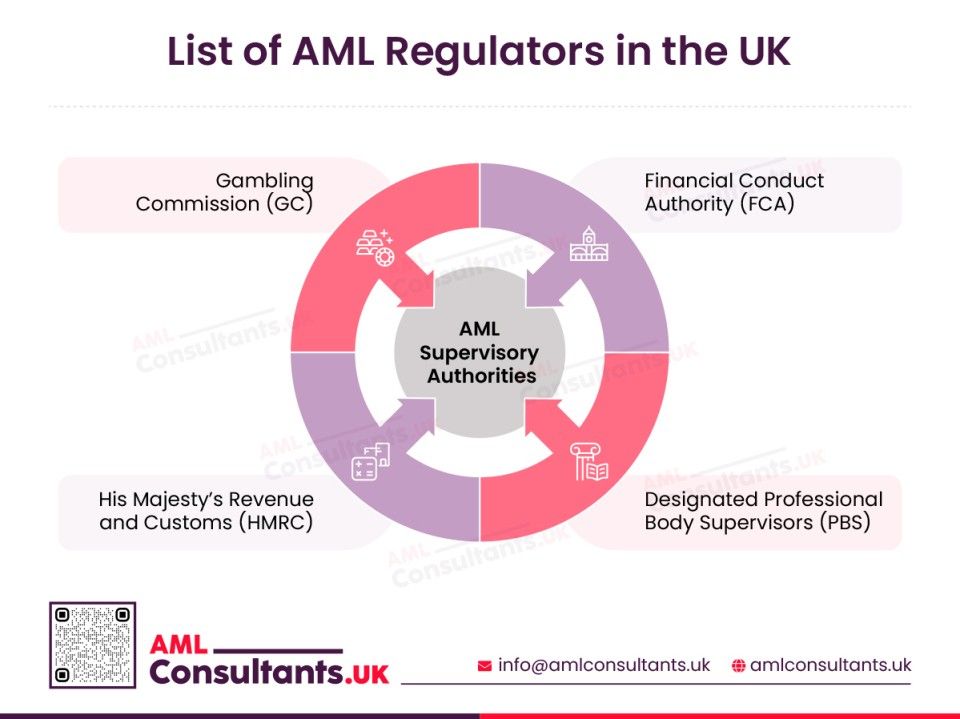
Who Supervises AML in the UK?
- FCA supervises certain financial services firms and cryptoasset businesses in scope.
- HMRC supervises businesses such as certain MSBs, estate agency businesses, TCSPs, art market participants and others not supervised elsewhere.
- Professional body supervisors supervise many accountants, tax advisers, auditors, insolvency practitioners and legal professionals.
- Gambling Commission supervises casinos.
- OPBAS oversees professional body supervisors and is not the direct AML supervisor of firms.
The Financial Conduct Authority is an AML supervisory authority in the UK as per Regulation 7 of the MLR 2017.
The FCA, as an AML supervisor by sector, supervises the following:
- Credit Institutions
- Financial Institutions
- Crypto Asset Exchange Providers
- Custodian Wallet Providers
- Banks
- Building Societies
- Credit Unions
In addition to this, it plays a crucial role in supervising firms engaged in certain financial activities listed in Schedule 2 of the MLR, which are:
- investment managers and stockbrokers
- e-money institutions
- payment institutions
- consumer credit firms offering lending services
- financial advisers
- investment firms
- asset managers
- those providing safety deposit services
The FCA, as the UK AML regulator, lists the incorporation of robust AML policies and procedures as an essential measure to combat ML, TF, and PF.
There are 22 other Professional bodies listed in Schedule 1 of MLR, 2017 that supervise specific professional services.
Supervisory Professional Bodies for the Accountancy, Auditing and Bookkeeping Sector
- Association of Accounting Technicians
- Association of Chartered Certified Accountants
- Association of International Accountants
- Chartered Institute of Management Accountants
- Institute of Certified Bookkeepers
- Institute of Chartered Accountants in England and Wales
- Institute of Chartered Accountants in Ireland
- Institute of Chartered Accountants of Scotland
- Institute of Financial Accountants
- International Association of Bookkeepers
Supervisory Professional Bodies for the Legal Sector
- Chartered Institute of Legal Executives
- Council for Licensed Conveyancers
- Faculty of Advocates
- Faculty Office of the Archbishop of Canterbury
- General Council of the Bar
- General Council of the Bar of Northern Ireland
- Law Society (England and Wales)
- Law Society of Northern Ireland
- Law Society of Scotland
Supervisory Professional Bodies for the Taxation Sector
Supervisory Professional Bodies for Insolvency Practitioners
Office for Professional Body Supervisors
The Office for Professional Body Anti-Money Laundering Supervision is housed under the FCA and oversees the professional bodies.
The professional bodies include the following relevant persons:
- Auditors
- Insolvency practitioners
- External accountants
- Tax advisors
- Independent legal professionals.
In the UK, OPBAS is not a frontline AML supervisor of regulated entities, but it’s an oversight body within the FCA that supervises the Professional Body Supervisors in the legal and accounting sectors.
His Majesty’s Revenue and Customs undertakes AML supervision in the UK as per Regulation 7 of the MLR 2017. The following are the types of businesses that have to register for money laundering supervision with the HMRC:
- Money Service Businesses not supervised by the FCA
- High-value dealers handling cash payments for 10000 Euros or more on a single or linked transactions
- Art market participants where the transaction value >= 10000 Euros
- Estate agency businesses
- Trust or company service providers not supervised by the FCA or a professional body
- Accountancy service providers not supervised by a professional body
- Bill payment service providers are not supervised by the FCA
- Telecommunications, digital, and IT payment service providers not supervised by the FCA
- Letting agents renting property or land value at the equivalent of 10000 Euros or more a month.
HMRC necessitates implementing proper policies, procedures, and controls to mitigate and manage ML, TF, and PF.
The Gambling Commission is an AML supervisory authority as per Regulation 7 of the MLR 2017.
It places adequate controls to prevent gambling businesses, such as casinos, from being used as hubs for Money Laundering (ML) and Terrorism Financing (TF) activities.
As an AML supervisory authority, the GC also requires gambling businesses to stay up to date with all emerging risks and implement effective measures to mitigate them.
Transform Your CDD Program.
Let AML Consultants UK Manage Your CDD Requirements.
AML Supervisory Framework: Who Regulates What
Here is the table highlighting the AML Supervisory framework in the UK:
| Sector | Main AML Supervisor | Legal Basis / Notes | Example Businesses |
|---|---|---|---|
| Banks and financial institutions | FCA | Regulated firms within FCA AML remit | Banks, building societies, credit unions |
| Cryptoasset exchange providers | FCA | In scope under MLR registration regime | Crypto exchanges |
| Custodian wallet providers | FCA | In scope under MLR registration regime | Wallet service providers |
| Accountants supervised by a professional body | Relevant PBS | Depends on membership and supervisory status | ICAEW firms, ACCA firms |
| Legal professionals supervised by a professional body | Relevant PBS | Depends on professional body and regulated activity | Solicitors, barristers, conveyancers |
| Tax advisers supervised by a professional body | Relevant PBS | Subject to body-specific AML supervision | CIOT, ATT members |
| Insolvency practitioners supervised by a professional body | Relevant PBS | Depends on insolvency supervisory route | IPA members |
| Accountancy service providers not supervised elsewhere | HMRC | HMRC supervision applies where no PBS supervision applies | Independent bookkeeping/accounting firms |
| Estate agency businesses | HMRC | HMRC supervision applies | Estate agents |
| Trust or company service providers not supervised elsewhere | HMRC | Applies where not supervised by FCA or PBS | Formation agents, registered office providers |
| Money service businesses not supervised by FCA | HMRC | HMRC supervised population | Currency exchange, remittance businesses |
| Casinos | Gambling Commission | Gambling Commission supervises casinos | Land-based or remote casino operators |
AML Frontline Supervisors Vs. Oversight Bodies
To understand the UK AML supervisory framework, it is important to distinguish between bodies that directly supervise regulated businesses and bodies that oversee the supervisors themselves. The table below clarifies this distinction and identifies which authorities act as frontline AML supervisors and which ones play an oversight role within the wider supervisory system.
| AML Regulatory Body | Type | Directly Supervises Firms? | Role of AML Regulatory Authority |
|---|---|---|---|
| FCA | Frontline supervisor | Yes | Supervises certain financial institutions and crypto businesses in scope |
| HMRC | Frontline supervisor | Yes | Supervises specified businesses not supervised elsewhere |
| Professional Body Supervisors (PBSs) | Frontline supervisors | Yes | Supervise firms in legal, accountancy, tax and insolvency sectors |
| Gambling Commission | Frontline supervisor | Yes | Supervises casinos for AML purposes |
| OPBAS | Oversight body | No | Oversees professional body supervisors, not regulated firms directly |
What AML Inspectors Ask For
The AML Supervisory Authorities that regulate AML in the UK are responsible for acting as AML supervisors for their respective sectors.
AML supervisory authorities in the UK conduct routine inspections of firms and businesses to understand the effectiveness of the AML programme and compliance with the laws within the regulated entities.
The inspectors request copies of documents and information related to AML, such as internal audits conducted in accordance with AML procedures and controls, external auditors’ reports, bank statements, training records, customer identity documents, and Suspicious Activity Reports (SARs) submitted, etc.
The UK AML regulators list several compliance obligations, such as Customer Due Diligence (CDD), Ongoing Monitoring, Record-Keeping for 5 years, etc., which inspectors assess comprehensively.
Inspectors also assess the understanding of staff and members on AML by speaking with them directly to ascertain inspection readiness in the UK AML.
AML Supervision UK: Common Findings and Remediation Themes
Firms and businesses are expected to make full use of inspections and surveys, which help mitigate ML/TF risks prevalent in their specific sectors.
The AML Supervisory Authorities carry out targeted/thematic inspections depending on the risks associated with the authorised person. They conduct desk-based inspections, targeted inspections, or full inspections.
The inspection is followed by a report that includes common findings, the scope of AML coverage, deficiencies, and observations made during the inspection. This ensures inspection readiness for UK AML.
The deficiencies can be effectively addressed by implementing enhanced checks and providing regular training for staff to ensure they are ready for inspection.
The inspection is supported by self-assessments taken by the organisation, which help in identifying areas that are partially met and must be supported through remediation plans to include the identified areas.
The remediation plan must reflect the deficiencies and incorporate measures undertaken to address gaps and help during on-site inspections to ensure Inspection readiness in UK AML.
Navigating the Inspection Requirements Comes Easy with Us.
Let Us Help You in Becoming Inspection Ready!
AML Supervision UK:Recent Trends and Enforcement Focus (March 2026)
As the UK’s Economic Crime Plan evolves, Supervisory Authorities have shifted their focus from “having a policy” to “demonstrating effectiveness.” Current trends include:
1. Increased Focus on Proliferated Financing (CPF)
Since the inclusion of Counter-Proliferation Financing (CPF) in the MLR, inspectors are now specifically looking for CPF-specific risk assessments. Firms must demonstrate they understand the difference between Terrorist Financing and Proliferation Financing.
2. The "De-Banking" and Risk-Based Approach Debate
The FCA has increased pressure on firms to ensure they are not “de-risking” (wholesale closing of accounts for entire sectors) but are instead applying a nuanced, Risk-Based Approach (RBA).
3. Data-Led Supervision
The HMRC and FCA are increasingly using data analytics to flag “outlier” firms. This means your digital record-keeping isn’t just for your own audit. It is the primary data source for the regulator’s remote desk-based reviews.
4. OPBAS 2.0 Effectiveness
The Office for Professional Body Anti-Money Laundering Supervision (OPBAS) has entered a “high-intensity” phase. They are no longer just checking if Professional Bodies (like the Law Society or ACCA) have rules, but are testing if those bodies are actually issuing fines and stripping memberships from non-compliant members.
Key Enforcement Insight: In the last 12 months, the most common reason for heavy fines wasn’t a failure to spot a criminal, but a systemic failure in Governance. Specifically, senior management is not able to explain their own firm’s risk appetite.
How AML Consultants UK Supports Implementing AML Legal Obligations by Supervisory Authorities Effectively
The AML Legal Obligations set forth by Supervisory Authorities are crucial. They must be implemented compulsorily to ensure Relevant Person adhere to the AML compliance requirements of their respective Supervisory Authorities.
AML Consultants UK help Relevant Persons understand their compliance obligations. This includes optimising the Customer Due Diligence (CDD) process by integrating identification, verification and as part of a standard compliance check.
It also offers services covering Firm-Wide Risk Assessment and Policies, Procedures, and Controls, which are designed to work in sync. The FWRA helps assess ML, TF and PF risks while the Policies, Procedures and Controls help safeguard the Relevant Persons from such ML, TF and PF risks.
Additionally, the whole AML Legal Framework in the UK remains incomplete without imparting AML Training to the frontline staff and employees.
In order to support all this, AML Consultants UK helps set up an in-house AML Compliance Department that would be responsible for implementing AML Compliance for the regulated business.
FAQs: AML Supervisory Authorities
What is AML supervision in the UK?
AML Supervision refers to the oversight by supervisory authorities over the activities of relevant persons.
Why is AML supervision crucial, and what role do AML Supervisory Authorities play in this?
AML supervision is crucial to keep ML, TF, and PF risks at bay. The AML Regulatory Authorities in the UK ensure firms and businesses are aware of their AML obligations and compliant with the MLRs.
Who supervises AML in the UK?
The Financial Conduct Authority (FCA), the Designated Professional Bodies (PBS), His Majesty’s Revenue and Customs (HMRC), and the Gambling Commission (GC) supervise their respective sectors.
What ensures inspection readiness for UK AML?
Inspection readiness in UK AML is assessed by maintaining proper documentation, ensuring audits are in place, and conducting appropriate training for staff and members of the organisation, among other measures.
What does the AML inspection entail?
AML Inspection focuses on risk assessment, internal controls and policies, CDD, transaction monitoring, staff training, and SAR submission to NCA through UKFIU to prevent ML and TF.